
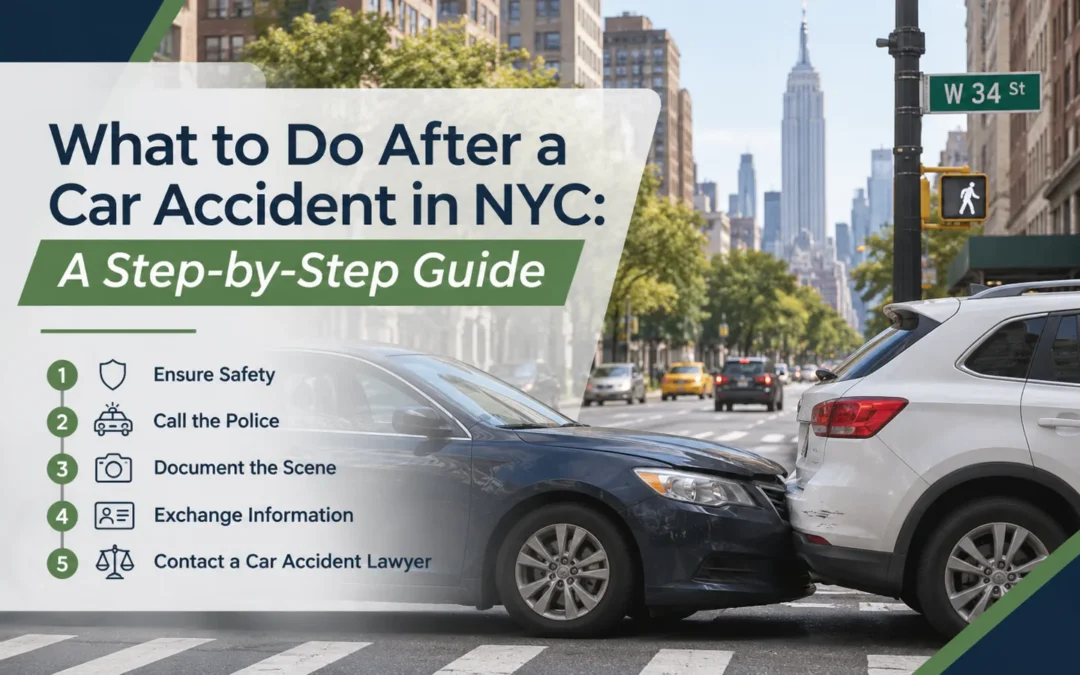
A car accident in New York City can leave you dealing with more than vehicle damage. You may be worried about injuries, insurance paperwork, missed work, medical bills, and what you should or should not say in the hours and days afterward.
The most important thing is to focus first on safety and medical needs. After that, take reasonable steps to document what happened, exchange required information, preserve records, and notify the appropriate insurance company.
Every accident is different. The steps below provide general information about what people commonly need to consider after a crash in New York City.
IN THIS GUIDE
- Check for Injuries and Get to a Safe Location
- Know When the Accident Must Be Reported
- Exchange Driver, Vehicle, and Insurance Information
- Document the Scene Before Important Details Disappear
- Preserve Medical, Repair, and Expense Records
- Notify the Appropriate Insurance Company Promptly
- Be Careful With Statements About Fault
- Obtain the Police Crash Report if One Was Prepared
- Avoid Common Post-Accident Mistakes
- When Should You Speak With a Lawyer After an NYC Car Accident?
KEY TAKEAWAY
After a car accident in NYC, prioritize safety and medical attention, report the crash when required, exchange information, document the scene and injuries, preserve records, notify the appropriate insurer, and avoid making assumptions about fault before the facts are clear.
New York also has specific accident-reporting and no-fault insurance requirements that may apply depending on the circumstances.
1. Check for Injuries and Get to a Safe Location
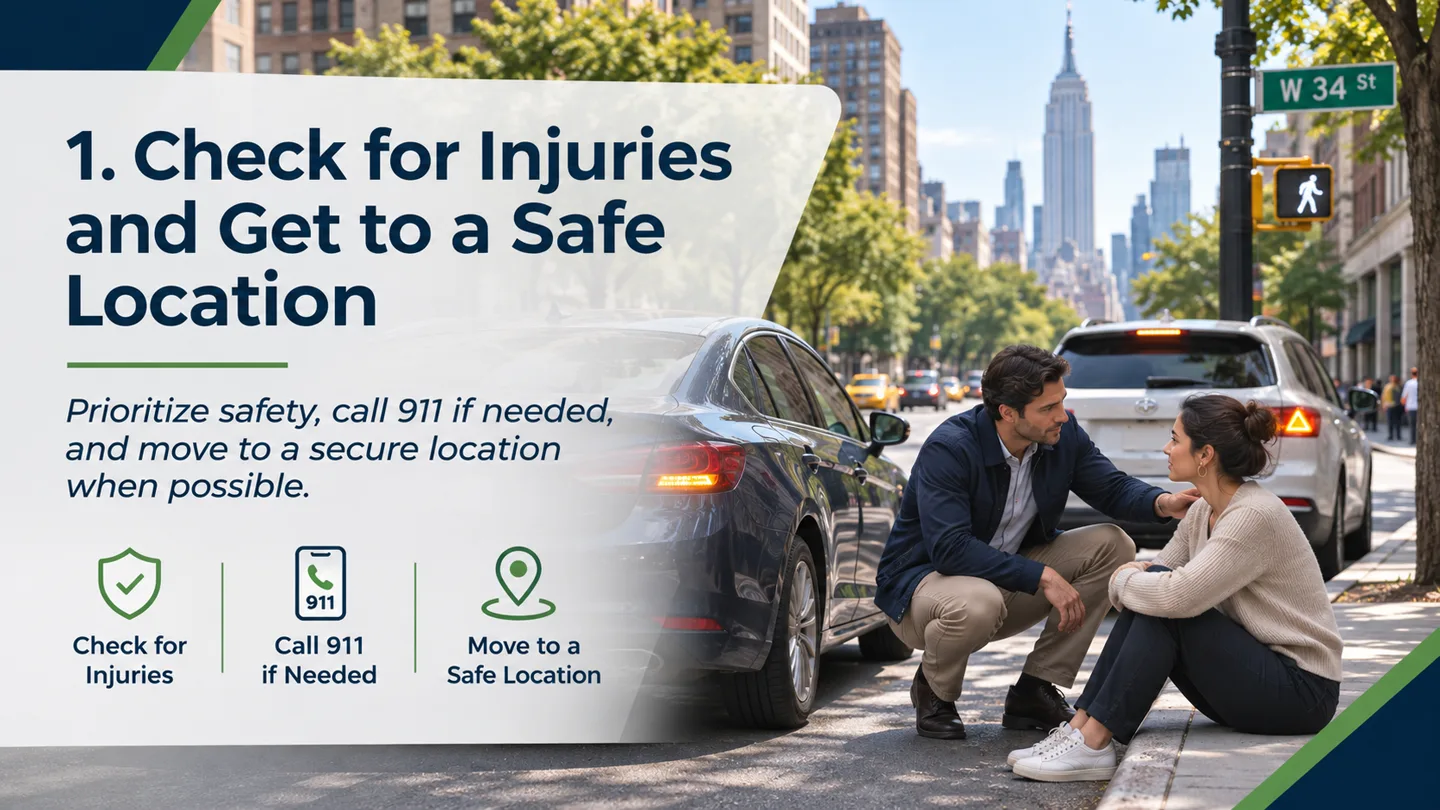
Your first priority after a collision should be safety.
If you or anyone else may be injured, call 911 and request medical assistance. New York City guidance also recommends calling 911 when a vehicle needs to be towed or when certain property has been damaged and the owner cannot be located.
If the vehicles are operable and no one appears injured, move to a secure location when it is safe to do so. This can reduce the risk of another collision and help keep traffic moving.
Even when an injury is not immediately obvious, pay attention to how you feel after the crash. Some symptoms may become noticeable later. If you have concerns about an injury, seek appropriate medical attention.
2. Know When the Accident Must Be Reported
Not every collision is handled the same way.
For a crash involving only property damage, New York City guidance states that police reporting is generally not required when the motorists can exchange the necessary information.
However, New York law requires additional reporting in certain situations.
A Report of Motor Vehicle Accident, Form MV-104, must generally be filed with the New York State Department of Motor Vehicles within 10 days if the crash:
- caused a death,
- caused a personal injury, or
- caused more than $1,000 in damage to the property of any one person.
Separate police-reporting obligations may also apply depending on what occurred at the scene.
Because reporting requirements can affect both legal and insurance issues, do not assume that reporting the accident to an insurance company satisfies every reporting obligation.
3. Exchange Driver, Vehicle, and Insurance Information
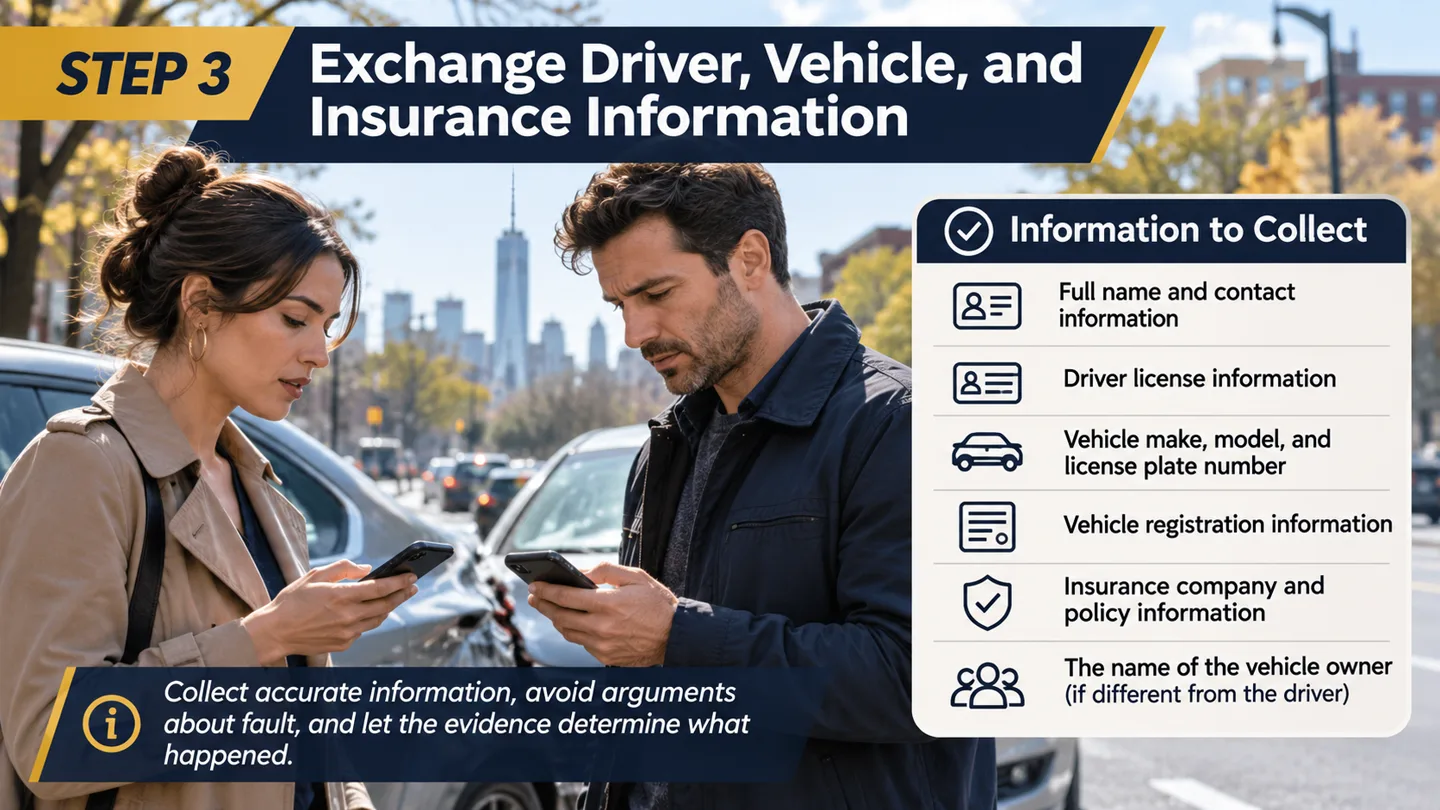
When possible, exchange information with the other driver or drivers involved.
Useful information to collect includes:
- full name and contact information,
- driver license information,
- vehicle make, model, and license plate number,
- vehicle registration information,
- insurance company and policy information, and
- the name of the vehicle owner if the driver is not the registered owner.
Avoid arguing about who caused the crash. The scene can be stressful, and fault may depend on evidence that is not immediately available.
The goal at this stage is to collect accurate information, not to reach a legal conclusion at the roadside.
4. Document the Scene Before Important Details Disappear
If you can safely do so, document the scene.
Photos and videos may help preserve details that can change quickly after a collision, including:
- vehicle positions,
- visible damage,
- skid marks or debris,
- traffic signals and signs,
- road and weather conditions,
- construction or roadway hazards,
- nearby businesses or cameras, and
- visible injuries.
It can also be useful to record the date, approximate time, exact location, direction each vehicle was traveling, and anything you remember about the moments immediately before the collision.
If there were witnesses, ask for their names and contact information. Witnesses may leave before police or insurance representatives have an opportunity to speak with them.
5. Preserve Medical, Repair, and Expense Records
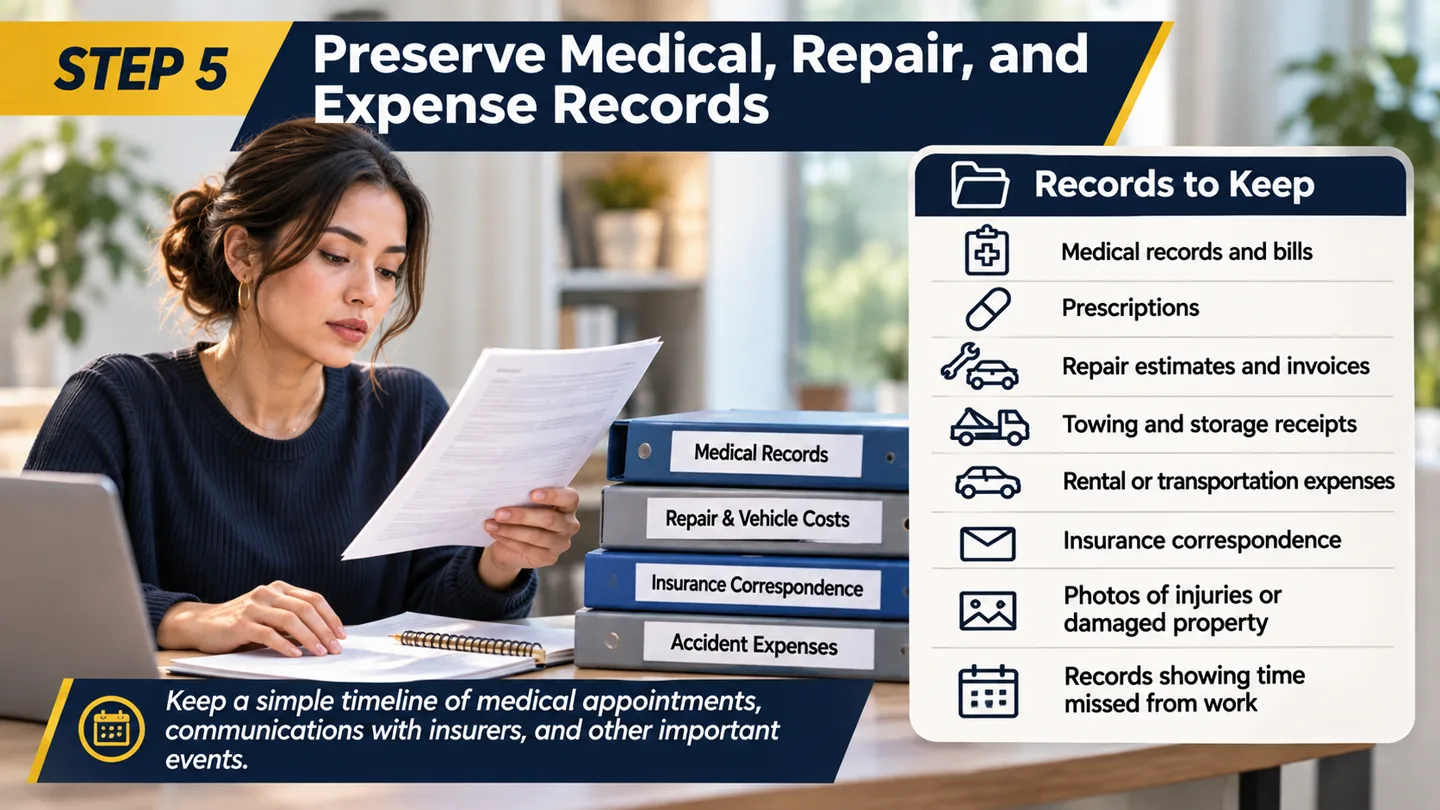
Documentation does not end at the crash scene.
Keep copies of records connected to the collision, including:
- medical records and bills,
- prescriptions,
- repair estimates and invoices,
- towing and storage receipts,
- rental or transportation expenses,
- insurance correspondence,
- photos of injuries or damaged property, and
- records showing time missed from work.
You may also want to keep a simple timeline of medical appointments, communications with insurers, and other important events.
Organized records can make it easier to understand the financial and practical impact of the accident later.
6. Notify the Appropriate Insurance Company Promptly
New York is a no-fault automobile insurance state.
For eligible injured people, no-fault coverage can apply to certain accident-related economic losses regardless of who caused the crash.
The New York Department of Financial Services states that written notice of a no-fault claim generally must be provided as soon as reasonably practicable and no later than 30 days after the accident, unless there is a clear and reasonable justification for a delay.
The appropriate insurer may depend on whether you were a driver, passenger, pedestrian, or were involved under other circumstances.
Insurance policies may also contain their own notice requirements, so it is important to review the policy and respond promptly.
If you are unsure which insurer should receive notice, or whether a deadline applies to your situation, consider getting guidance before assuming that the issue can wait.
7. Be Careful With Statements About Fault
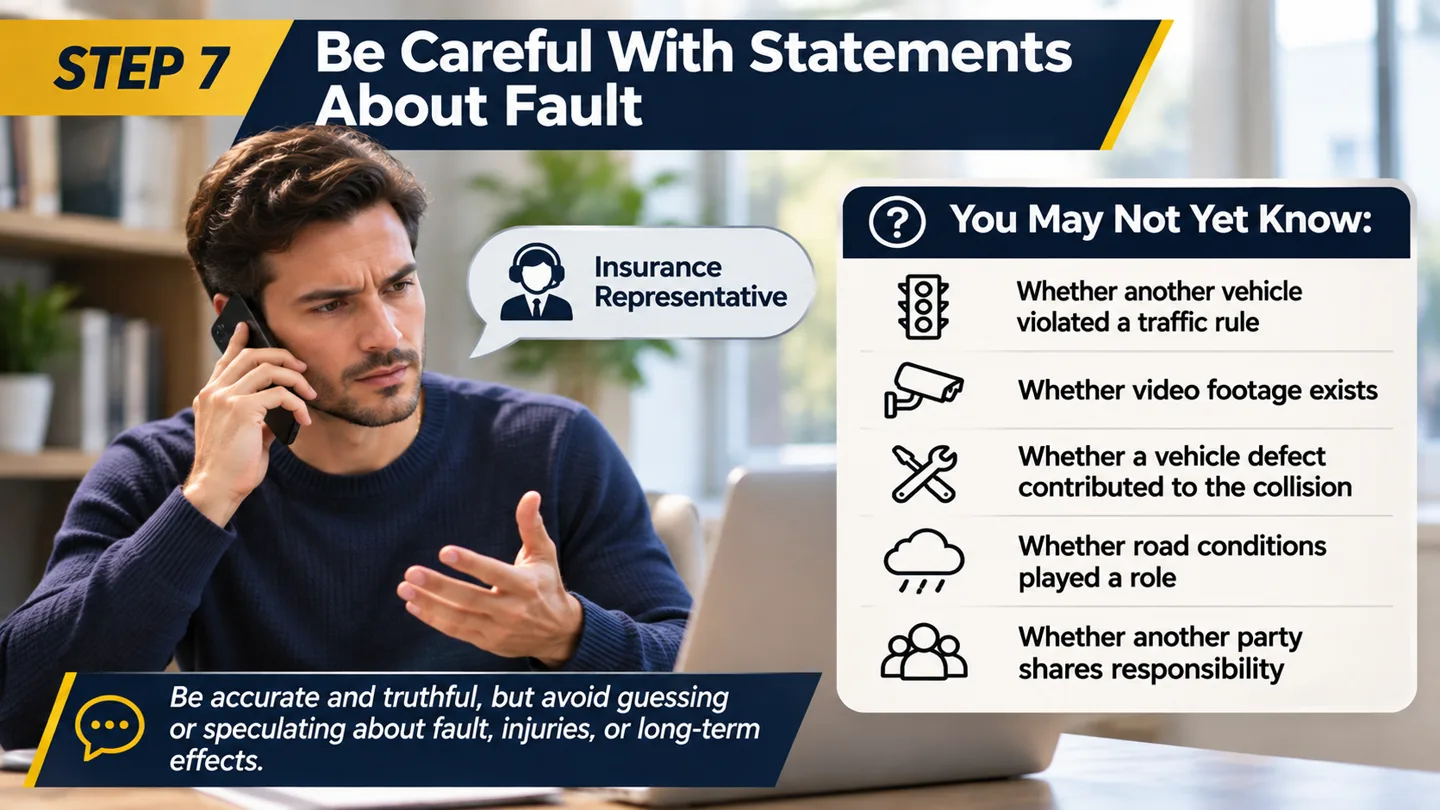
After a crash, you may be contacted by insurance representatives and asked to describe what happened.
Be accurate and truthful, but avoid guessing.
You may not yet know:
- whether another vehicle violated a traffic rule,
- whether video footage exists,
- whether a vehicle defect contributed to the collision,
- whether road conditions played a role, or
- whether another party shares responsibility.
New York accident cases can involve questions about how responsibility is allocated among the people or entities involved. A quick statement made before all the facts are known can create unnecessary confusion later.
You also do not need to speculate about injuries, recovery time, or long-term effects before medical professionals have had an opportunity to evaluate you.
8. Obtain the Police Crash Report if One Was Prepared
If police responded and prepared a crash report, obtaining a copy may help you verify important details about the incident.
In New York City, police crash reports may be available through the NYPD during the initial period after the collision and later through the New York State DMV.
A crash report is only one piece of the overall record. Photos, witness information, medical records, vehicle evidence, and other documentation may also matter.
9. Avoid Common Post-Accident Mistakes
Every situation is different, but some actions can make an already difficult situation harder.
Consider avoiding the following:
- leaving the scene before required information has been exchanged,
- ignoring an injury or delaying needed medical attention,
- losing photos, receipts, or insurance correspondence,
- posting detailed statements about the accident on social media,
- signing documents you do not understand,
- assuming the other driver’s insurer will protect your interests, or
- waiting until the last minute to address reporting or insurance requirements.
A careful approach is usually better than rushing to resolve everything immediately.
10. When Should You Speak With a Lawyer After an NYC Car Accident?
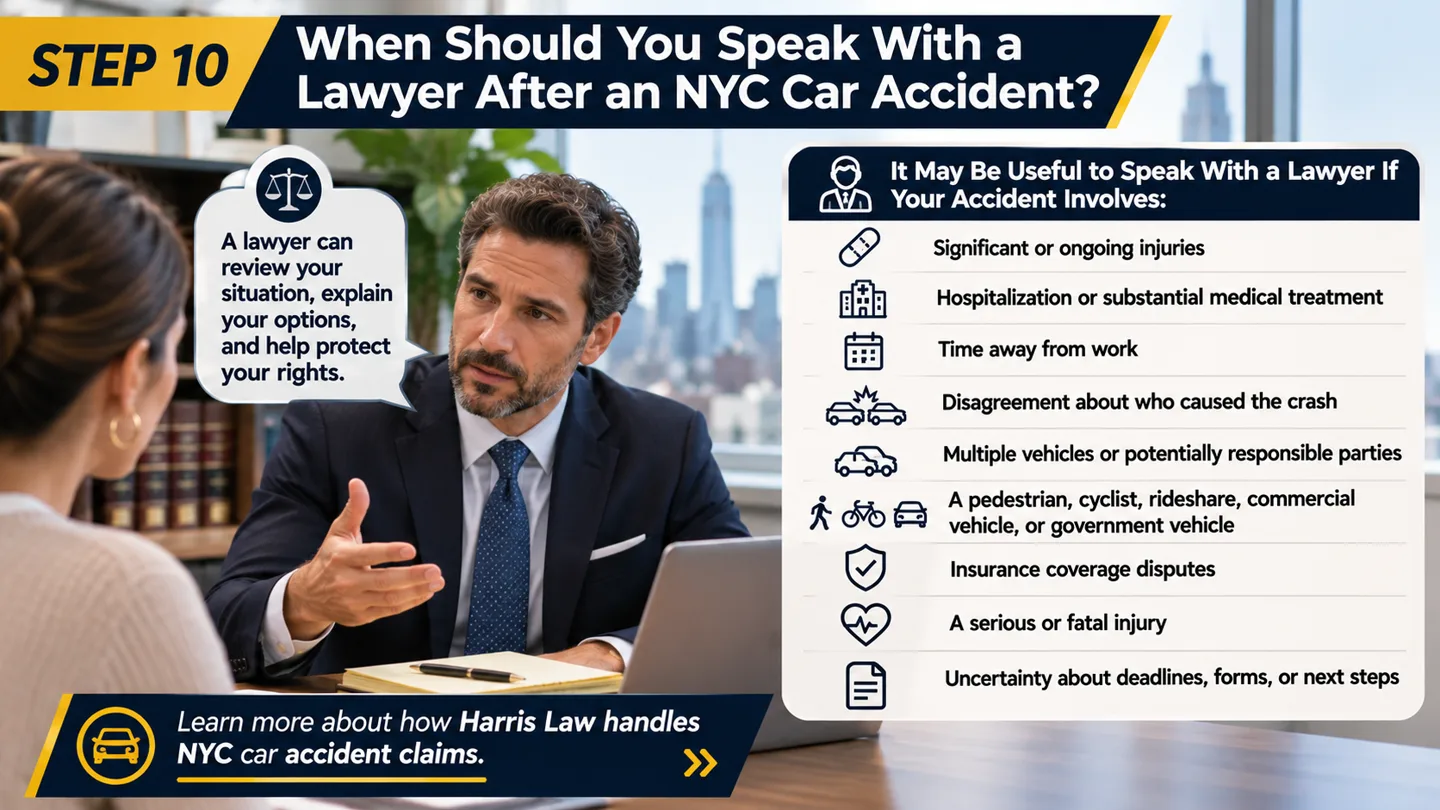
Not every crash requires legal representation.
However, it may be useful to speak with a personal injury attorney when the accident involves issues such as:
- significant or ongoing injuries,
- hospitalization or substantial medical treatment,
- time away from work,
- disagreement about who caused the crash,
- multiple vehicles or potentially responsible parties,
- a pedestrian, cyclist, rideshare, commercial vehicle, or government vehicle,
- insurance coverage disputes,
- a serious or fatal injury, or
- uncertainty about deadlines, forms, or next steps.
An attorney can evaluate the specific facts, explain what laws and insurance rules may apply, help preserve relevant evidence, and identify issues that may not be obvious immediately after the collision.
Learn more about how Harris Law handles NYC car accident claims:
Frequently Asked Questions
Do I need to call the police after every car accident in NYC?
Not necessarily. New York City guidance states that collisions involving only property damage generally do not have to be reported to police when the motorists can exchange the required information. However, police should be contacted in circumstances such as injuries or death, certain property damage where the owner cannot be located, and other situations identified by law or city guidance.
Do I need to file an MV-104 after a New York car accident?
You generally must file Form MV-104 with the New York State DMV within 10 days if the crash caused a death, personal injury, or more than $1,000 in damage to the property of any one person.
What is New York no-fault insurance?
New York’s no-fault system provides eligible people with coverage for certain economic losses arising from motor vehicle injuries regardless of who caused the accident, subject to the policy and applicable rules. The New York Department of Financial Services states that written notice of a no-fault claim generally must be provided no later than 30 days after the accident unless a valid justification for late notice applies.
Should I give a recorded statement to the other driver’s insurance company?
Insurance companies may request information after a crash. Before giving a detailed or recorded statement, make sure you understand who is requesting it and why. If you are uncertain about your obligations or how the statement could affect a claim, you may want to get legal guidance first.
How long should I keep records related to the accident?
Keep accident-related records organized while insurance, medical, or legal issues remain unresolved. This can include medical records, bills, repair documents, photos, insurance correspondence, wage-loss records, and other receipts connected to the collision.
RESOURCES:
Harris Law Resources
- NYC Car Accident Lawyers
- Personal Injury FAQ
- Representative Car Accident Case Results
- Contact Harris Law
Official New York Resources
- New York State DMV — Report of Motor Vehicle Crash (MV-104)
- NYC311 — Vehicle Accident Guidance
- New York State Department of Financial Services — No-Fault Insurance FAQs
- NYPD — Motor Vehicle Collision Reports
Have Questions About What to Do After a New York City Car Accident?
The period after a serious car accident can be confusing, especially when injuries, insurance requirements, and questions about responsibility overlap.
Harris Law represents people injured in New York City motor vehicle accidents. If you want to understand what information may matter to your situation and what options may be available, contact the firm for a free consultation.
Request a Free Case Evaluation
GENERAL INFORMATION DISCLAIMER
The information in this article is provided for general informational purposes only and is not legal advice for any individual case or situation. Reading this article does not create an attorney-client relationship.